Friday, February 20, 2015

Healthy food and an international hospital

That is the first impression of the food choices
It is quite a while ago that on Twitter a discussion started about the McDonalds branch at the Bumrungrad Hospital. It is indeed the most visible food vendor when you enter the Hospitals 1st floor. And quite a few people complain about it, since it doesn't really fit the otherwise healthy lifestyle that is promoted. 
Is this healthy food?


During the twitter discussion the person behind the Bumrungrad account claimed that they offer many different choices, and when I asked about vegetarian food I was referred to a restaurant at the clinics buildings 12th floor (what was closed last time I came) and the Food Court.

So when I had my recent appointment, I took the time to walk around the food vendors. Indeed. McDonalds is the most prominent, the first one and the biggest. Followed by Au Bon Pain, a sandwich seller and bakery. Then there is a Japanese restaurant, but I haven't seen it open before noon. And the Food court.


Those soups are available with fish at least.
First of all the Food Court offers Thai food, what is in general a good thing, because, hey, we are in Thailand. The problem with Thai food is only that it is not healthy in general. In particular the use of coconut milk and overuse of oil (mainly palm oil or soybean oil) makes it not so good. Many dishes are deep fried, what is the opposite of fresh, because it destroys most of the nutrional value. And nearly all Thai dishes are high in calories.

So what about the Food Court options? The result is a mix. They offer the non-healthy Thai food as well as some healthy dishes, kind of 50/50. I was surprised to even find a vegan stall (and the end of the first row in the far left corner), and I liked the fish dishes. 

There is also Starbucks with high calories and high fat pastries and sandwiches downstairs.

During the twitter discussion I was told I can find vegetarian and healthy food. The question is: Do I need to FIND healthy food in a hospital? Do I even have to SEARCH for it? Or should it be the most prominent offer, right when I enter the Food place.

I asked Bumrungrad some questions and it took the PR-Department 2 weeks to answer them.


1. Why does McDonalds has such a prominent exposure at the hospital and how does the McDonalds menu fit to Bumrungrads healthy food recommendations (like this https://www.bumrungrad.com/healthpoint/april-2014/foods-to-beat-the-summer-heat) ?

Answer:  " McDonalds food has been provided as one of the various choices for the relatives of our patient, visitors and general customers who come from various countries for their convenience while are visiting us."

2. The Food court offers a variety of Thai food, even vegan. 
And yes, there is a vegan corner!
 - what kind of cooking oil is used there?
- is there any reason why the calories of the meals can not be published on the signs? As far as I know calorie is the key issue in gaining and loosing weight.

Answer: "Our patient’s food has been provided by the expert team of Sodexo “Professional Food Provider”. The food provided for each patients is depend on the symptom of the patients and according to the doctor’s advice only."

3. What is Bumrungrad doing to actually provide healthy food in general, not as an exception? (I was told the restaurant in the clinic building is closed for renovation?)

Answer: "We have also provided healthy food including vegetarian with various kinds of food for our visitors, relatives and general customers at our food court “FOOD EXPERIENCE” & Japanese Restaurant “Ayame” as well."    


So, no answer regarding the oil that is used and about the calories suggestions. Unfortunately the usual PR-Blabla, and they didn't even read the question (or understand). I wonder if any doctor advises for high-cholesterol food.

Oh, and then I saw NO MSG signs. The thing is that MSG is not dangerous at all. It is an urban myth. It is in tomatoes and broccoli naturally, and it doesn't do ANY harm as longs as it it used in normal doses, like salt. 

So my conclusion: Bumrungrad is a business, not a charity. They want to make money, and it seems that McDonalds pays a good rent. Also, they want to make people feel good, not necessarily live good, so when patients see McDonalds, they may be happy.

By the way, of course McDonalds Food is not unhealthy per se.  It is just sooooo high in calories that it makes you fat. Obese, actually, when you eat a lot. Also, there is not much fiber, not many vitamins, and it is high on carbs. (BigMac, Fries, Sundae and Coke is 1500 calories. That is 3/4 of the daily average calorie intake you should have)

I wonder why Bumrungrad sticks so much on it? Most of their patients are Thai, by the way, even if it looks that people from the Middle East are. They may bring a lot of value, but they are not the majority. The message from Bumrungrad is clear: Eat whatever you want, we deal with the consequences (and this is where the money comes from at the end).

I remember that Samitivej Hospital in downtown has a Starbucks and and Au Bon Pain as well, but no fast food and a quite nice food hall downstairs.

Monday, February 16, 2015

This scary thing in Thailand: Electricity

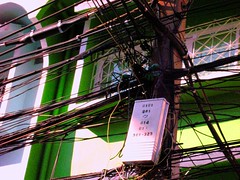
cables found in bangkokWe all have seen the cables hanging on poles along the street, and it looks like a total chaos for us, and dangerous as well. Surprisingly the danger doesn't really comes from this chaos, since there is order on the poles: Top level is high voltage, lower level is household electricity and the chaos comes actually from the telecom and internet companies.


But that doesn't mean electricity isn't scary here. It actually is. I am no expert and all and followed all my life the advise that you can fix a lot on things at home, but stay away from electricity. The problem is that most people here in Thailand actually think they are experts, and installation here seems to be more like an DIY way.


Today for example I plugged in the vacuum cleaner and suddenly the power socket was dead. I figured out all sockets upstairs are dead, but lights and aircon are just fine. Downstairs everything worked. Next step is then the breaker board. But all breakers were fine. I switched all off and on, but still the same problem. So I called the property management and they sent me the security (!) guard. He came with  a screwdriver style neon tester - good idea, only we have safe sockets that require both pins to be stuck in at the same time to release a plastic protection. He didn't know.

So far I explained him the problem, he was also surprised the breaker didn't go off, and then we switched all breakers on and off and on and off. And... drumroll.. all sockets were live again. So he was smiling all over his face and didn't really understand why I was still concerned - power was back, work was done, let's have a nap.

But the scary part is still that the breaker didn't switch off when there was - what I think caused it - a power surge by the vacuum cleaner. That's why we have breakers. I will now replace all circuit breakers with new ones.

My neighbor has a similiar problem when he found out that he has a small current of DC where there should be none, and if it should be AC.


I remember that in Vietnam most fires in homes were caused by bad or faulty wiring, and in Laos it was quite the same. It was so scary that the advice was to call first the electricity department so they shut off the whole street - without that the firefighters wouldn't do anything.

There are some websites about what is a safe installation in Thailand. Siam Info has a good summary.
Thailand Guru has some information about grounding and earthing (by the way it seems that lightning rods are not really common here.

In case you are in trouble we found this website from Service Genie (haven't tried them yet), and they seem to know what they do. HomePro is also offering installation service and repair service. They did a pretty good job with deliver and installation of our washing machine. And you can always call the MEA (Metropolitan Electricity Authority)

Tuesday, February 10, 2015

Impresssion from the market

We have a quite big market at the beginning of Sukhumvit 113, opposite of Imperial world. It is the typical Thai fresh market where you get anything from meat, fish, vegetables, fruits, but also take away food and household items.

He is quite a friendly guy who works in a butcher shop and was really proud to show his tattoos.


We still have a few samlo drivers here, they usually operate around the market.


Fresh from... we don't really know. Let's just hope it is Tilapa from a fish farm.


Thai food is nothing with out sweets, Those are coconut custard dishes. 


It is not just the Chinese influence and the fact that Chinese New Year is coming: grilled ducks and chicken are available everywhere.

Friday, February 6, 2015

Adopt a special dog in Thailand: Tong Tang needs a home


One of my neighbors takes care of stray dogs around Ekkamai, and one dog needs a home now since he lost one of his front legs. The hospital in Ekkamai had to cut the front left leg off, but it seems to heal well. The problem is that Tong Tangs future is not so bright: He may end up in a shelter with hundreds of other dogs.


I do have a three leg dog as well, and it doesn't make much of a difference, only she gets quickly tired , so if you are a lazy dogwalker, that might be an advantage.


If you are interested, please contact Khun Chompoo, 0876983098, or mookaow@yahoo.com


Thursday, February 5, 2015

It's getting a bit fishy...

I am not really sure if they just sell the fish or also dry the fish next to the street. 


Thursday, January 22, 2015

Some pictures from the everyday life in Bangkok

Every morning I see many good photo motives when I drive my wife to the BTS, and so I decided to stop on the way back and take some pictures. Actually the morning hours between 5am and 9am and the evening, starting from 5pm to midnight are the most exciting hours in Bangkok. Or in other words: Between 9 am and late afternoon Bangkok is pretty boring. Most people are at work, it is too hot to go outside anyway, so nothing is really going on. Life comes back when the sun goes lower, the heat is blown away and people start buying dinner.

In this post I will add pictures from the morning, taken between Soi Bearing and Soi Wat Dan Samrong.


Wednesday, January 14, 2015

Organ transplants and organ donation in Thailand

When I am in the gym I like to watch 40 minutes episodes of TV series, and I really like any kind of hospital and emergency reality shows. In one episode a patient was in urgent need of a new heart, and I was wondering, if there would be any way to get a new heart in Thailand - and if there are even facilities.

Another reason is that a good friend from Vietnam is suffering from kidney failure and waiting for a transplant. My father once donated his bone marrow to his brother who had leukemia. My uncle survived, sadly my dad got stomach cancer soon after and died when I was in my 20s.
Kidney transplant; Source https://www.flickr.com/photos/ndguard/.
CC-BY-SA

So what is the state of organ transplants in Thailand? (NOTE: INFORMATION ABOUT A DONOR FORM AT THE END OF THE ARTICLE)

The association in charge are the Thai Transplantation Society and The Red Cross in Thailand. The kingdom is the one of participants in the Istanbul Summit that is followed by "The Declaration of Istanbul on Organ Trafficking and Transplant Tourism" . The strategies include : increase the donor pool, prevent organ trafficking, transplant commercialism, and transplant tourism, encourage legitimate, life-saving transplantation programs. So it is embedded in the international transplant society.

The Red Cross in in charge as the Thai Organ Donation Center. It's objectives are:

1. To serve as a place where prospective organ donors can be registered, while they are alive, to have their relatives arrange for the member hospitals to acquire the organ tissue upon their death.
2. To coordinate among hospitals where donor patients die.
3. To serve as a place where prospective recipients nationwide can be registered.
4. To allocate donated organ tissue in a fair and academically sound manner.
5. To examine tissue compatability for transplants and other laboraory examinations.
6. To serve as a public relations center providing news and information about organ donations to medical practitioners and related professionals as well as the public.
7. To contact organ donation centers in neighboring countries on behalf of recipients, and to represent Thailand in future organ tissue exchange programs.

The Thai Transplantation Society is more like a medical association, assuring certain standards like the Brain Death Criteria Standard. Thailand has a well established "Brain death criteria" since 1989. This is endorsed by "The General Medical Council of Thailand " which has been assigned as the acting body of The Ministry of Public Health concerning the regulation of the medical practice of the country. The "Brain death criteria" is the standard means to identify potential deceased organ donors.

Organ transplants are conducted in Thailand for quite a while. Kidney transplants are the number one on the list, but liver, heart, lungs and bone marrow are done as well. Thailand was the first country in ASEAN to perform heart transplantation twenty one years ago. The first organ transplantation in Thailand was a renal transplantation at Chulalongkorn Hospital in 1972. After that, transplantation was gradually developed, and today bone marrow, liver, heart, lung, and heart and lung transplantations are undertaken in 26 hospitals
around the country.

It is a bit difficult to get actual numbers, but at least for kidney transplants I found a report by the Thai Transplantation Society. It says that in 2012 a number of 465 were made. Of these, 251 transplants came from deceased donors and 214came from living donors. These transplantations took place in 24 transplant centers.

The top hospitals for kidney transplants in 2012 were:
Ramathibodi 118
Srinagarind 61
Siriraj 60
Praram 41
Maharaj Nakorn Chiang Mai 37
King Chulalongkorn Memorial 32
Sappasitthiprasong 21
Vajira 18
Rajavithi 14

Yes, the fancy ones like Bumrungrad are doing transplants as well, but on a much lower scale. A side note: When you use the - not well implemented - search function at the Bumrungrad website, you will see a lot of hair transplant results are coming up. Tells a bit of the priorities there (I could not find any link if they do heart or liver transplants).

Regarding the legal framework, a study done by Rachata Tungsiripat and Viroj Tangcharoensathien in 2003 describes it very well (although I am aware it is a bit outdated, but I guess it hasn't changed much since it follows basically international standards)


We all know that there are laws and regulations in Thailand and then there is reality. It sometimes seems this is actually are proof of the existence of parallel universes. Here and then we hear stories about organ trafficking and trade. Recently there was a report of a Thai kidney trading ring, bringing Cambodian donors to Thailand and selling their organs to rich Thais or medical tourists. The Bangkok Post reported and quoted the CDC:
"Prompted by concerns over trafficking the ODC, which oversees organ donations, launched a pilot project in April making it compulsory for hospitals to provide them with details of living donors. "

"Before they could come to Thailand without our knowledge... We are concerned about hospitals where they are not following rules, that's why we asked for a register of living donors," said ODC director Visist Dhitavat.

While regulations are being tightened experts fear the booming medical tourism industry in Thailand, reputed for high-quality but low-cost care, could give rise to more criminal networks cashing-in on the vulnerable.

"It could be the tip of the iceberg," said Jeremy Douglas, United Nations Office on Drugs and Crime representative for Southeast Asia and the Pacific, on the recent Cambodian arrests.

So, as with any other crime in Thailand, organ trade surely exists, but we don't know on what scale. Anyway, stories of body snatchers grabbing you after a traffic accident and selling your organs while you are still alive are usually something for movies.

But biggest problem is - like in any country - the lack of donors. And this is now the part of the story that involves YOU, my dear reader. If you made it through the article (or just jumped to the end), you will now get some information about how to become an organ donor. It is quite easy. Most important, you have to be dead. Brain dead. (And please forget those stories that they will let you more likely die on a operating table when you are a donor. That is again from the movies.)

As defined by the Thai Red Cross:

1. The donor must be under 60 years of age.
2. The donor has died from cerebral death.
3. The donor is free of infectious disease and cancer.
4. The donor does not have any chronic diseases such as diabetes, heart conditions, kidney disorder, hypertension, liver disease, or alcoholism.
5. The organ to be donated must be fully functional.
6. The donor must have no diseases that can be transmitted through organ transplants e.g. hepatitis-B, AIDS.
7. Please inform your family members or relatives of the donation.

To become a donor:
1. Fill out an intention form (it is in Thai, I am working on a translation). Confirm that the given address corresponds with that shown on the residence registration. (Please indicate if you wish to have the donor ID card mailed to a different address.)

2. Type and mail the intention form to the Organ Donation Center, Thai Red Cross (address below). Once the form is received and processed, your donor ID card will be sent to the address you have indicated.
3. After receiving the ID card, make sure you put your name and details of the donation on it.
4. Keep the ID card. If it is lost or stolen, contact the Organ Donation Center, Thai Red Cross.

Organs Donation Center, Thai Red Cross
Therdprakiet Somdej Phrayanasungworn (Charoen Suwattano) Bld., 5th Floor
Henry Dunant Road, Pathumwan,
Bangkok 10330
Tel: 1666

In Thailand alone there were 4,321 people on the organ waiting list up until August 2014 with deceased donors' organs forming around half of the 581 kidneys transplanted last year, according to the Thai Red Cross Organ Donation Centre (ODC). So please, help other people after your are gone from this life and donate your organs. This way you not only CAN but you WILL make a difference. Thank you.

(I am filling the form right now and will attach the organ donor ID card to this article as soon as I receive it)